
Issue 94: Connections Lost and Found
I crossed paths with a stranger and walked away with a gift so meaningful that I decided to share it with you.

The Ohio State University is one of the most important institutions in my life, and this week I was reminded why - twenty years after graduating - my affinity for my alma mater continues to reward me in unexpected ways.
This story begins with my father.
He grew up in central Ohio in the 1950s and 1960s, in an opportunity-scarce environment not unlike the world depicted in J.D. Vance’s Hillybilly Elegy. As a child, I admired my father because I knew he came from very little and, through a combination of individual talent and sheer stubbornness, managed to extricate himself - first through military service, and later by applying himself academically at Ohio State - from that life. This didn’t come easy. First he started taking classes at one of Ohio State’s regional campuses before making his way to Columbus. He didn’t do it alone. My mother - who grew up in a radically different world of middle-class New England - stood by his side, urging him to keep going, to graduate, and eventually pursue a law degree.
I don’t think my father loved Ohio State as a student. Already in his thirties, campus life probably didn’t offer him all that much. But, much like Vance - who was “lucky enough to live the American Dream” - my father was also haunted by the demons of the life he left behind (coincidentally, Vance also studied at Ohio State). Between the emotional weight of growing up in a broken home and the shame he carried from his upbringing, my father’s affiliation with Ohio State became a singular point of pride. It was something he should share with his children, even as he quietly swept the rest of his childhood under the rug.
So my siblings and I grew up Buckeyes, setting the timer on the television so that we could watch the Scarlet and Grey beat THE TEAM UP NORTH - The University of Michigan - on the final Shabbat of November. Not exactly kosher, but it was the only way to connect with my father’s roots.
As a child, I loved my father and deeply admired his ability to build a new life for himself. By extension, I developed an emotional attachment to Ohio State and came to see it as an integral part of my family’s history. It was the only university I seriously considered after high school, and my undergraduate years there proved as transformative and fulfilling as any experience of my life.
In January 2003, just months into my freshman year, Ohio State defeated the University of Miami to win the National Championship - its first title in more than thirty years. I remember huddling with my father in our frigid basement, and the shared exhale as Miami quarterback Ken Dorsey’s desperate pass fluttered into a pack of Buckeye defenders in the end zone. The entire state of Ohio erupted in incoherent celebration, and so did my dad and I. It one of last joyful memories we shared.
This week, I packed up my things for work and stepped out of our apartment. Just a few meters from my door, I saw a man coming up the hill wearing an Ohio State sweatshirt.
That wouldn’t be unsual in the United States. It isn’t even rare at an international airport. But in Jerusalem - some 6,000 miles from Columbus - it was downright outlandish. In my twenty years living here, I would dare say that I among the very few Ohio State alumni in the city, let alone diehards willing to wear Scarlet and Grey in public. It was such a bewildering and incongruous site that I considered keeping my mouth shut and letting the man go about his day.
But I couldn’t help myself.
“Hey, that’s a nice sweatshirt,” I said as I passed.
He turned to face me.
“This?” he asked, pointing to the letters, “you mean Ohio State?”
I was already taken aback. He had a clear American accent. That sweatshirt didn’t come to him by accident.
“Yes,” I said. “It’s a beautiful sweatshirt. I went to Ohio State.”
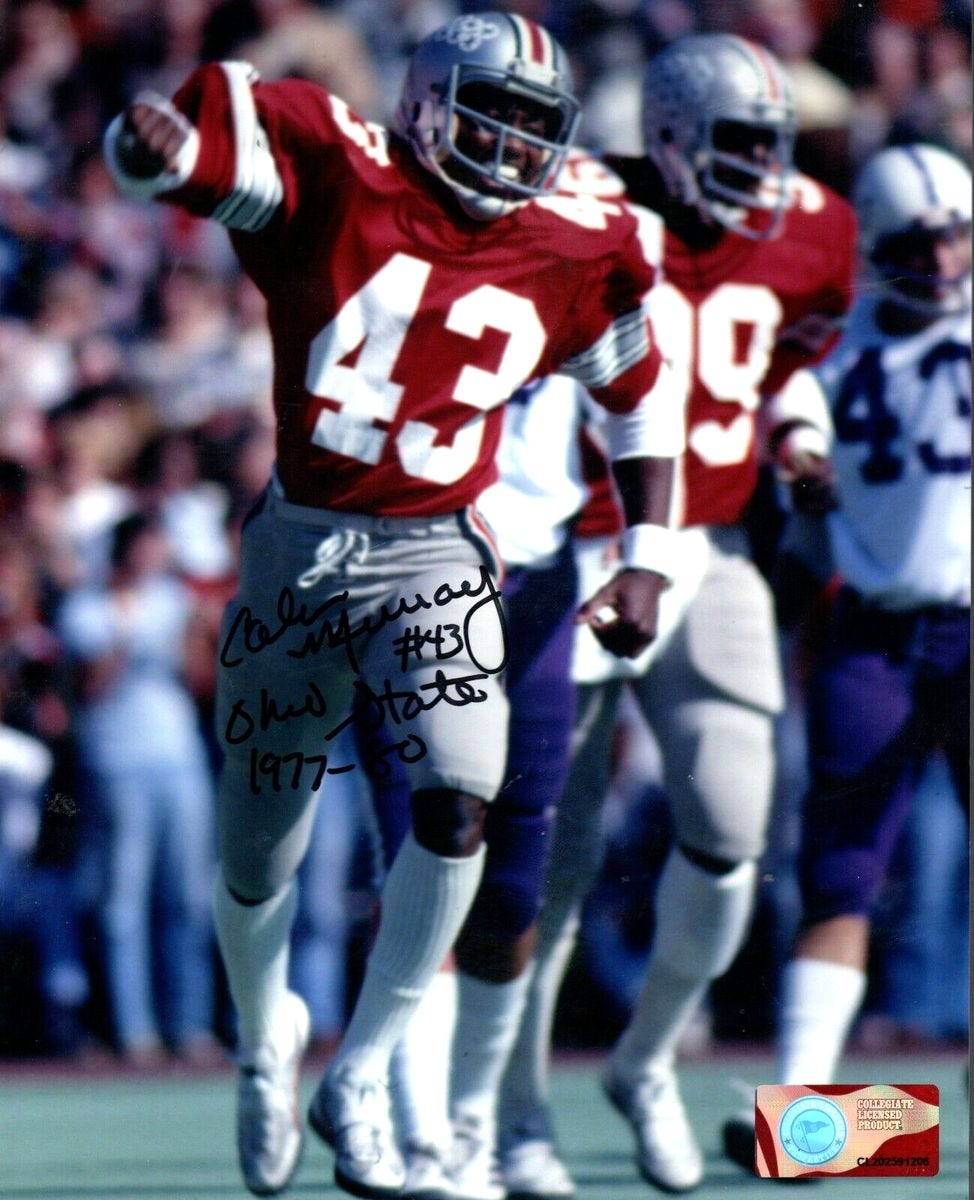
He paused, then replied, “I played for the Buckeyes and was coached [by the legendary] Woody Hayes.”
My mouth went dry. For a moment, I lost all sense of space, place, and time.
“Huh?”
“I played for Ohio State,” he repeated. “When did you go to school there?”
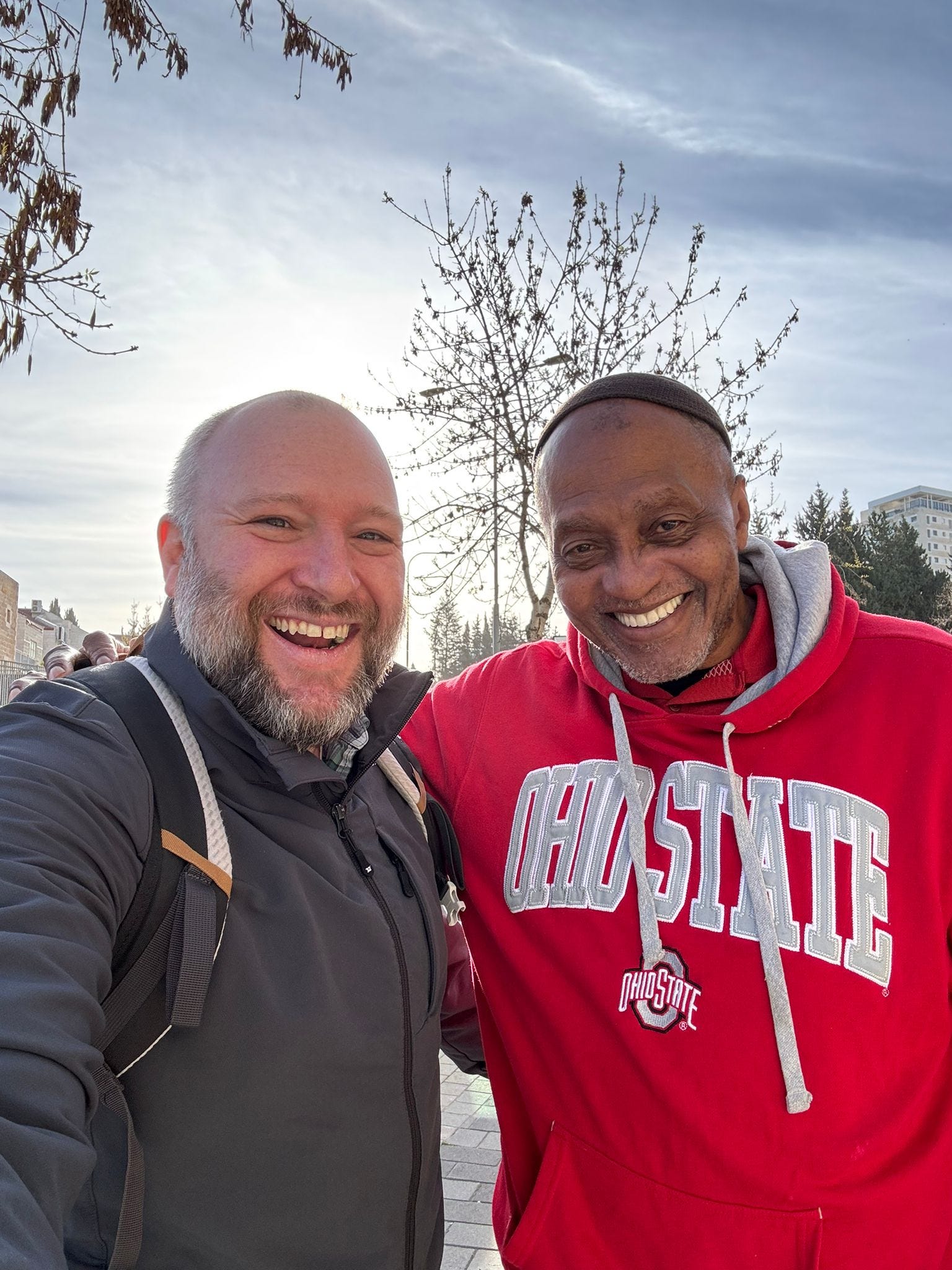
We ended up standing on that unassuming street corner in southern Jerusalem, talking at length. Our shared bonds were obvious: our alma mater, our faith, and our city. It was more than enough.
His name was Calvin Murray. Later in life, he found Judaism, converted - like my father - and took the name Yosef. He had been Ohio State’s starting running back, still holding several significant records, including being named the team’s Most Valuable Player in 1980. He also enjoyed a brief professional career.
We exchanged stories. He asked how I came to Ohio State, but seemed even more curious about how I ended up in Jerusalem. Naturally, I was equally curious about him. While African American Jews are an integral part of many communities in the United States, it is far less common meet them in Israel. He told me about the spiritual journey he and his wife had undertaken, their pursuit of truth and God in Jerusalem, and how they maintaining relationships with their children who remained stateside.
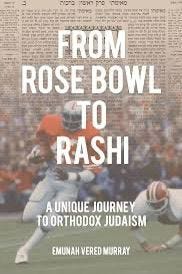
“We even wrote a book about it,” he said. From Rose Bowl to Rashi.
As a Buckeye, I was embarrassed to admit I had never heard of it, yet there it was, sitting on Amazon.
I don’t regularly take photos, but couldn’t resist asking him for a selfie. I knew that without proof, no one would believe me.
“Thank you so much,” I said as we parted, “You really made my day.” (It was 08:32 in the morning.)
“No, no - thank you,” he replied. “You didn’t have to say anything. Most people don’t talk to strangers anymore. Who knows? The person right right next to us might be the Mashiach (Messiah), and we would never know because we don’t bother to speak up. Because you stopped and said hello, we met. I should be thanking you.”
I don’t believe in the Messiah or the End of Days. But I do believe that some of life’s greatest gifts come when we choose to engage with strangers without expecting anything in return. I didn’t even expect Yosef (Calvin) Murray to speak English, let alone have so much in common with me. What began as a moment of Buckeye recognizing Buckeye touched the topsoil of my identity - my love for Ohio State and all it has given me - but ultimately reached deeper: to my father, my childhood, the person I am, and who I hope to become.
I crossed paths with a stranger and walked away with a gift so meaningful that I decided to share it with you.
We should say hello to strangers more often.
Thanks for taking the time to read. As always, I welcome your comments and questions.
Best,
Gabi
I love this post. There is so much here! Of all of it, I most identify with this sentence:
"Most people don’t talk to strangers anymore. Who knows? The person right next to us might be the Mashiach (Messiah), and we would never know because we don’t bother to speak up..."
One of the things I miss most when riding the buses here is actual human interaction. In the early 1990's, when I was here as a student, people talked to strangers on the bus all the time. I had some of the most meaningful conversations of my life with strangers, none of whom I would ever see again. Now, too often, everyone (myself included) have their eyes glued to their phones. When I do talk to someone, they often look at me at first like I might be crazy.
Thank you for this fascinating post, for the vulnerability of sharing about your family, and for the reminder to talk to strangers!
Heartwarming story! Todah